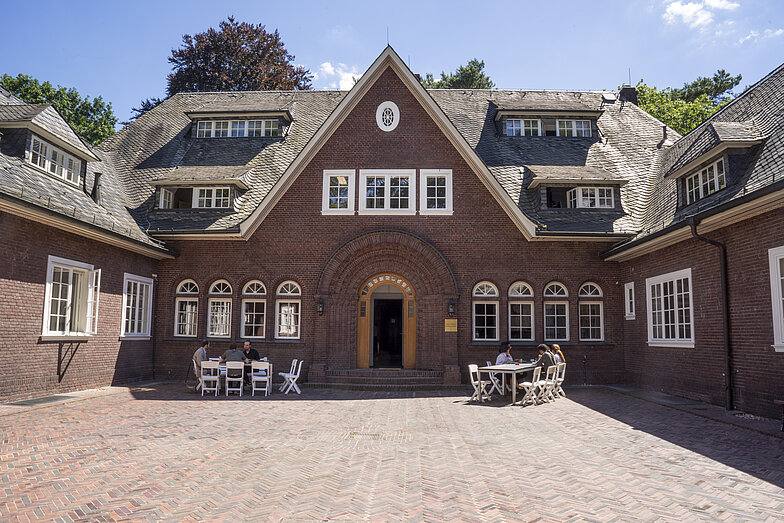
Leibniz-Zentrum Moderner Orient (ZMO) emerged from the "History of the Developing Countries" section of the Institute of General History in the German Democratic Republic’s Academy of Sciences. This field of work goes back to a department of the Prussian Academy of Sciences through several intermediate departments, including the “Institut für Orientforschung” from 1947 to 1968. This department was originally established in 1912 as the “Orientalische Kommission”.
Following German reunification, ZMO was founded in 1991 as "Forschungsschwerpunkt Moderner Orient" under the patronage of the Max Planck Society. In 1996 it was established as a non-university centre for historical, cultural, and social sciences. The umbrella organisation for ZMO is the Berlin Centers for Advanced Studies in the Humanities (Geisteswissenschaftliche Zentren Berlin e.V.), whose membership includes, among others, Berlin universities and several German academies. The core scientific programme is currently funded by the Senate Chancellery Higher Education and Research of the Federal State of Berlin, the German Research Association DFG, and the Federal Ministry of Education and Research. On 1 January 2017, the Centre joined the Leibniz Association (see also Joachim Nettelbeck in the FAZon 21.09.2016). It is located in Berlin-Nikolassee in the Mittelhof, designed by Hermann Muthesius and built between 1914 and 1918.